


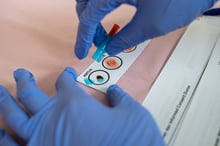
 Levels of p-tau217, a validated Alzheimer's disease biomarker, can be accurately detected from blood samples derived from a finger prick and dried on a testing card, according to a report in Nature Medicine.
Why It’s Relevant
Last year, the FDA cleared the Lumipulse G pTau217/β-Amyloid 1-42 Plasma Ratio and Elecsys pTau181 blood tests—the first blood-based tools for detecting Alzheimer’s disease.
Though venous blood draws are more accessible than brain scans or spinal fluid collection, they can still cause discomfort, and the blood samples require timely refrigeration and special processing. The possibility of analyzing biomarkers using non-refrigerated blood spots could facilitate even greater access to Alzheimer’s testing.
By the Numbers
- Researchers assessed levels of the Alzheimer’s biomarker p-tau217 from dried blood and venous plasma samples provided by 304 adults from seven clinical centers across Europe. They found the levels of p-tau217 in dried blood strongly matched those in venous blood.
- Tests of the dried blood samples could identify people with abnormal p-tau217 levels (identified via spinal fluid assays) with about 86% accuracy.
- The most accurate cutoff value between normal and abnormal was a p-tau217 concentration of 0.016pg ml−1.
- Thirty-one of the study participants had Down syndrome—a known risk factor for Alzheimer’s disease—and the dried blood test also proved accurate for this population, which is typically underserved in clinical studies.
The Other Side
Though encouraging, an 86% accuracy level is not considered high enough for routine clinical use, the researchers noted (the venous blood tests were 98% accurate). There was also wide variability in accuracy among the seven study centers, indicating the testing protocol needs further refinement.
Takeaway Message
“Our findings demonstrate that dried blood analysis offers a feasible and scalable approach for detecting [Alzheimer’s] pathology, particularly in research, population-based, and epidemiological contexts,” the researchers wrote.
Related Information
Source
Hanna Huber, et al. A minimally invasive dried blood spot biomarker test for the detection of Alzheimer’s disease pathology. Nature Medicine. Published January 5, 2026. doi: doi.org/10.1038/s41591-025-04080-0
(Image: Getty Images/iStock/rio agusta)