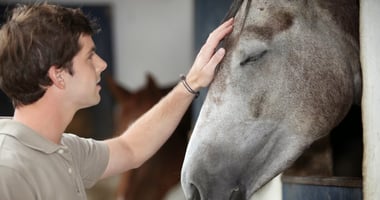


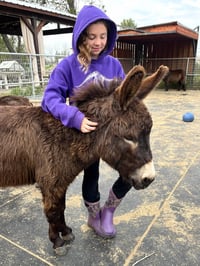
 Spending just three minutes with miniature horses and donkeys helped adolescents feel less nervous, sad, and lonely, according to a study published in Scientific Reports. What’s more, the animals’ responses to human touch affected the degree of mood improvement.
Why It’s Relevant
Human-animal interactions have long been used to improve mental health symptoms such as anxiety and depression. Researchers aimed to bridge a gap in the literature by understanding how the animal’s engagement during the interaction impacts emotional outcomes among people. For example, among equines, lip wiggling is a behavioral cue indicating a positive emotional reaction whereas walking away indicates a desire for disengagement.
By the Numbers
- Divided into groups, 61 adolescents (67% female) spent three minutes engaging with a herd of two miniature horses (named Olivia and Randy) and two miniature donkeys (named Mary and Memphis).
- Participants experienced reductions in nervousness, sadness, and loneliness after the interaction, as well as an increased sense of calm.
- Those who observed lip wiggling among the equines reported loneliness scores that on average were 0.215 points lower (on a seven-point scale) than those who did not, after controlling for baseline score.
- Surprisingly, those who observed the equines walking away during the interaction reported sadness scores that on average were 0.115 points lower than those who did not. The researchers hypothesized that seeing animals exercise voluntary choice may have reinforced a sense of agency in the adolescents.
The Other Side
This study’s sample size was small, and the participants self-reported their emotional states, possibly introducing bias. Further, the study relied on a small, consistent group of equines, limiting how this assessment might apply across animal species.
Takeaway Message
“Our work raises this beautiful possibility that making the interaction better for the animal may be part of what makes it better for us,” study author Rebecca Calisi Rodríguez, Ph.D., M.S., director of the Green Care Lab at UC Davis, said in a news release. “This has the potential to change how we think about designing animal-assisted interventions, from hospitals and schools to therapeutic riding centers and beyond.”
Related Information
Source
Claire J. M. Short and Rebecca M. Calisi. Mutual wellbeing in an equine-assisted intervention: experimental evidence for the two-way hypothesis and the importance of interaction method. Scientific Reports. Published online September 15, 2026. doi:10.1038/s41598-026-65168-2
(Photo credit: Claire Short/UC Davis)