


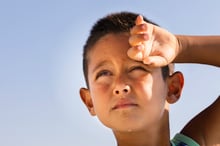
 Young children exposed to average maximum temperatures higher than 32°C/89.6°F are less likely to be developmentally on track compared with those exposed to cooler temperatures, a study in the Journal of Child Psychology and Psychiatry has found.
Why It’s Relevant
Increasing evidence suggests that climate change has significant effects on both physical and mental health. However, less is known about how exposure to excessive heat early in life affects foundational skills.
By the Numbers
- Researchers examined developmental and climate data from the households of 19,607 children ages 3 and 4 from across six nations: Georgia, The Gambia, Madagascar, Malawi, Sierra Leone, and the State of Palestine.
- Children who were exposed to an average maximum temperature of 32°C/89.6°F or hotter were between 1.8 and 7.7 percentage points less likely to be developmentally on track overall compared with children who were exposed to average maximum temperatures lower than 26°C/78.8°F.
- Among developmental subdomains, rising temperatures had the strongest and most consistent influence over literacy-numeracy skills; children in hotter climates were 5 to 6.7 percentage points less likely to be on track in this domain.
What Else Stood Out
Exposure to high temperatures had particularly severe effects on children from poor households, urban areas, and households with limited access to essential services.
The Other Side
Although the researchers could accurately assign temperature levels to children who remained in the same area throughout their lives, this is not possible for those who migrated. In addition, heat exposure can make children tired, unmotivated, or sleepy, potentially affecting their performance on childhood assessments.
What’s Next
“[F]uture research should explore potential mechanisms and additional moderators that could be relevant for interventions and policy, such as families’ adaptive behaviors in response to heat,” the researchers wrote. “Additionally, targeted programs for economically disadvantaged families are essential to ensure the equitable protection of human development across the course of life.”
Related Information
Source
Jorge Cuartas, et al. Ambient heat and early childhood development: a cross-national analysis. J. Child Psychol. Psychiatry. Published December 8, 2025. DOI: https://doi.org/10.1111/jcpp.70081