


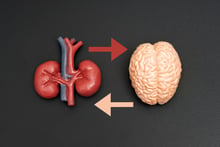
 Several categories of mental illness are linked to declining kidney function, according to a study in General Hospital Psychiatry.
Why It’s Relevant
While prior research has suggested that individuals with mental illness have a higher risk of kidney disease, those studies evaluated only a few psychiatric disorders. Understanding how the broader array of mental illnesses are associated with poor kidney outcomes can help identify patients who could benefit from screening and closer follow-up.
By the Numbers
- Researchers analyzed Japanese health insurance claims data for roughly 3 million adults, among whom 10.1% had at least one mental illness.
- Individuals with any mental illness had a 12% higher risk of a poor kidney outcome—onset of end-stage kidney disease, a 30% or greater decrease in estimated glomerular filtration rate, or kidney transplantation or dialysis—than those without mental illness.
- Disorders with the highest risk of poor kidney outcomes were personality disorders (137% higher), organic mental illness arising from disease or brain injury (80% higher), and eating disorders (69% higher).
- Substance use disorder, schizophrenia, mood disorders, neurotic disorders, and stress-related and somatoform disorders also increased risk, while intellectual disabilities, developmental disorders, and behavioral disorders did not.
The Other Side
It’s possible that early declines in kidney function may contribute to mental illness rather than mental illness contributing to poor kidney outcomes. In addition, the high risk seen with organic disorders should be interpreted cautiously because the underlying medical or neurological problem may independently affect the kidneys.
Takeaway Message
“[O]ur findings underscore the need to integrate kidney health into routine care for adults with mental disorders, particularly those with psychiatric multimorbidity,” the researchers wrote. “Clinicians may [also] consider targeted assessment and management of common co-occurring problems in this population—such as sleep disturbance, constipation, and lower urinary tract symptoms—as well as careful review of medications that may affect kidney risk.”
Related Information
Source
Ryunosuke Mitsuno, et al. Mental disorders and subsequent kidney function decline: a nationwide cohort study in Japan. General Hospital Psychiatry. Published online August 10, 2026. doi:10.1016/j.genhosppsych.2026.08.007
(Image: Getty Images/iStock/Ekaterina Chizhevskaya)