

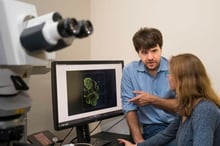
 Karl Deisseroth, M.D., Ph.D., the D.H. Chen Professor of Bioengineering and of Psychiatry and Behavioral Sciences at Stanford University, was co-awarded the 2026 Nobel Prize in Physiology or Medicine today, alongside German researchers Peter Hegeman, Ph.D., of Humboldt University, and Georg Nagel, Ph.D., of the University of Würzburg.
The trio were recognized for their contributions to optogenetics—a protocol that allows researchers to modulate nerve signals in living brains using light energy.
Why It’s Relevant
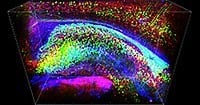
Optogenetics involves the injection of special light-sensitive proteins called opsins into specific neurons. When these “tagged” neurons are hit with the right wavelength of light, they are turned either on or off. By using multiple opsins sensitive to different colors, researchers can manipulate different brain circuits and see how neurons influence behavior. “Optogenetics provides opportunities for mapping the brain in a way that we could once only dream of,” noted Per Svenningsson, M.D., Ph.D., chair of the Nobel Committee for Physiology or Medicine.
By the Numbers
- Hegeman and Nagel set optogenetics in motion with their 2002 discovery of an algal protein called channelrhodopsin. When this protein was exposed to blue light, it triggered electrical activity in the algae, enabling it to move toward the light.
- In 2005, Deisseroth and colleagues successfully inserted channelrhodopsin into cultured rat neurons, and then managed to stimulate electrical activity in these cells.
- In 2012, Deisseroth’s team used optogenetics to induce or tone down depressive behaviors in living animals.
What’s More
Deisseroth is the first psychiatrist to win a medical Nobel since Eric Kandel in 2000, and just third overall (Julius Wagner-Jauregg was the first in 1927).
Takeaway Message
“I couldn’t be happier, because the trio that the committee picked spans the progression from the early algal explorations all the way to advanced neuroscience experiments, so this prize really captures the full journey of discovery,” Deisseroth said in a Stanford news release. He added that he will use his new platform as a Nobel laureate to advocate for continued research into the brain: “I’ve done my best so far with the voice I’ve had, and I’ve tried to reach out to everybody—everybody who can listen and who wants to listen about science, about psychiatry, and about health.”
Related Information
(Image: Courtesy Stanford Medicine)