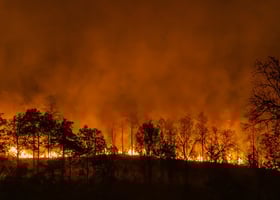


 Particulate matter from wildfire smoke is associated with increased emergency department (ED) visits for migraine and other primary headache syndromes, according to a study in JAMA Network Open.
Why It’s Relevant
As currently seen in Europe and Canada, human exposure to wildfire smoke—especially fine particulate matter (PM2.5) that can enter the bloodstream—is a growing public health concern. A potential link between wildfire smoke and headaches could be particularly significant, as headaches are a leading cause of years lived with disability globally and a risk factor for psychiatric disorders such as depression and anxiety.
By the Numbers
- Researchers analyzed data from nearly 1 million headache-related ED visits during peak wildfire season (May through October) between 2010 and 2023 in Alberta and Ontario, Canada.
- There was a 6.07% increase in ED visits for migraine and other headaches on days with elevated wildfire-sourced PM2.5 compared with non-wildfire days.
- There was no significant uptick in ED visits on days where PM2.5 was elevated due to other causes.
- Across both provinces, ED visits for headaches on wildfire days increased the most (10.42%) among patients in the top quintile of material and social deprivation, but there was no clear linear pattern of headache risk across the five quintiles.
The Other Side
The researchers lacked information on preexisting diagnoses of migraine and other chronic headache conditions and/or medication use, which could have prevented or minimized headache severity. They also could not measure the patients’ indoor and personal exposure to wildfire smoke.
Takeaway Message
The researchers noted that the variation in wildfire-related ED visits across social and material deprivation status may reflect factors such as an individual’s housing quality, access to air conditioning, occupation (e.g., mainly working outdoors), baseline health status, and health care access. “Further research examining potential mediating pathways, including mental health-related mechanisms, and evaluation of interventions, such as reducing smoke exposure through indoor air filtration, N95 masking, and other avoidance strategies, may help inform future public health responses,” the researchers wrote.
Related Information
Source
Robert Dales, et al. Wildfire-sourced PM2.5 and emergency department visits for migraine and other primary headache. JAMA Network Open. Published online July 24, 2026. doi:10.1001/jamanetworkopen.2026.25015
(Image: Getty Images/iStock/EngemPostscriptum)